In today’s hyper-connected world, our smartphones are indispensable companions, serving as navigators, entertainment hubs, and vital communication tools. While driving, ensuring your phone is both secure and sufficiently charged presents a common challenge. Do you opt for a simple phone holder that provides stability, or a sophisticated wireless charger that keeps your device powered without fumbling for cables? This comprehensive guide will dissect the advantages and disadvantages of each solution, helping you determine the ideal setup to match your lifestyle, budget, and safety priorities.
Understanding Phone Holders and Their Types
A phone holder, also known as a phone mount or cradle, is designed primarily to secure your smartphone in a fixed, accessible position, enabling hands-free operation. This simple yet effective accessory enhances safety by keeping your eyes on the road and your hands on the wheel, minimizing distractions often associated with handling a phone while driving. Beyond the car, phone stands offer ergonomic benefits for desk or home use, preventing “tech neck” by elevating your screen to eye level.
There’s a wide array of phone holder types, each suited for different environments and preferences:
Car Mounts
Car mounts are designed specifically for vehicle interiors, ensuring your phone remains stable even on bumpy roads. The most common attachment styles include:
- Dashboard Mounts: These attach to your dashboard, often using adhesive or suction cups, providing a clear line of sight near eye level. They offer good stability but can sometimes leave residue or be affected by extreme temperatures.
- Windshield Mounts: Similar to dashboard mounts, these utilize suction cups to adhere to the windshield. They offer excellent visibility for navigation but might obstruct a small portion of your view, which could be illegal in some regions.
- Air Vent Mounts: Clipping onto your car’s air vents, these are generally compact and less obtrusive. However, some cheaper models might wobble, interfere with airflow, or even damage delicate vent blades.
- CD Slot Mounts: Utilizing the CD player slot for attachment, these offer a sturdy mounting point without blocking the windshield or dashboard. This is a good option if you no longer use your car’s CD player.
- Cup Holder Mounts: These fit into your car’s cup holder and typically feature an adjustable arm to bring the phone to a comfortable viewing height. They are very stable but occupy a valuable cup holder slot.
|
Our Picks for the Best Phone holder in 2026
As an Amazon Associate I earn from qualifying purchases.
|
||
| Num | Product | Action |
|---|---|---|
| 1 | Nulaxy Dual Folding Cell Phone Stand, Fully Adjustable Foldable Desktop Phone Holder Cradle Dock Compatible with iPhone 17 16 15 14 13 12 11 Pro Max Xs Xr X 8, Nintendo Switch, All Phones |

|
| 2 | LISEN Gooseneck Phone Holder for Bed Desk [3rd Upgrade] Cell Phone Stand for Desk Bed Gaming Accessories,Gifts for Men Mom Senior Tech Mount for Recording Filming Laying Down Flexible Magic Arm Clamp |
|
| 3 | EUCOS 62" Phone Tripod, Tripod for iPhone & Selfie Stick with Remote, Extendable Cell Phone Stand & Ultimate Phone Holder, Solidest Phone Stand Compatible with iPhone/Android |
|
| 4 | Lamicall Gooseneck Phone Holder for Bed - Cell Phone Mount Clamp Clip, Flexible Long Arm, Overhead Mount for Desk Headboard Bedside, Gifts for iPhone Air 17 Pro Max, 16 15 14 Pro Max and 4-7" Phone |
|
| 5 | ANDERY Car Phone Holder for Magsafe [78+LBS Strongest Suction & 2400gf Magnetic] 360° Adjustable Car Phone Mount, Phone Holders for Your Car for iPhone 17 Pro Max 16 15 14 13 12 Plus Air, Carbon Fiber |
|
| 6 | Qifutan Car Phone Holder Mount Phone Mount for Car Windshield Dashboard Air Vent Universal Hands Free Automobile Cell Phone Holder Fit for iPhone Smartphone Camera Mounts |
|
| 7 | [2026 True Military-Grade] Car Phone Holder VANMASS [Upgraded Strongest Suction & Clip] Cell Phone Mount for Dashboard Windshield Vent Wall,Truck Cradle Stand for iPhone 17 Pro Max 16 15 14 13 Android |
|
| 8 | Kaistyle for Magsafe Car Mount【20 Strong Magnets】Magnetic Phone Holder for Car Phone Holder Mount Dash Mounted Holders Cell Phone Holders for Your Car Accessories for Women Men for iPhone 17 16 15 14 |
|
| 9 | Qifutan Dash Mounted Holders Phone Holders for Your Car Phone Mount for Car Windshield Dashboard Air Vent Universal Desk Mounts Hands Free Automobile Cell Phone Holder Fit for iPhone Smartphone |
|
| 10 | Miracase Phone Holders for Your Car with Metal Hook Clip, Air Vent Cell Phone Stand Car Mount, Universal Automobile Cradle for Garmin GPS Fit iPhone Android and All Smartphones, Dark Black |
|
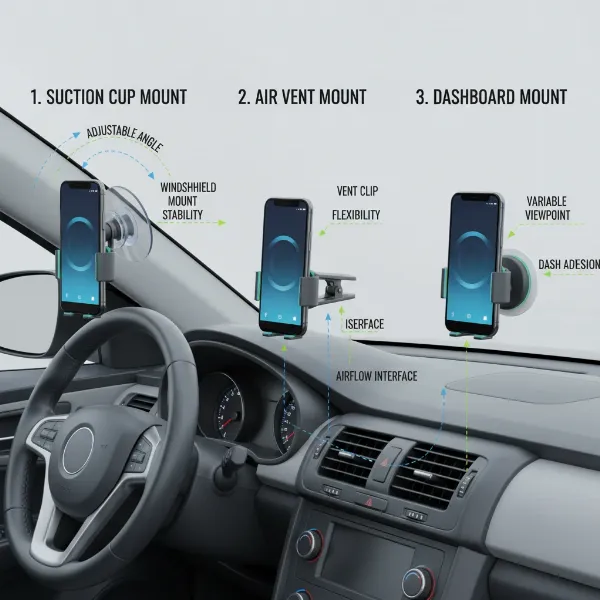 Various types of car phone holders including dashboard, vent, and windshield mounts, showcasing their diverse placements and designs for secure phone display while driving.
Desk and Wall Stands
For non-vehicle use, dedicated phone stands offer hands-free convenience at home or in the office.
- Desk Stands: These stands elevate your phone on a flat surface, ideal for video calls, watching content, or following recipes. They promote better posture and keep your workspace organized. While highly beneficial for stationary use, they are generally less portable than flat charging pads.
- Wall Mounts: Less common, these allow phones to be secured to walls, often in kitchens or workshops, for easy viewing of instructions or media without occupying counter space.
Essential Criteria for Choosing a Phone Holder
Selecting the right phone holder involves considering several factors to ensure it meets your specific needs and provides optimal functionality. A thoughtful choice can significantly enhance safety and convenience in various settings.
Compatibility
The first step is ensuring the holder is compatible with your device. Consider your phone’s size and model, as some holders are designed for specific dimensions or technologies like Apple’s MagSafe for iPhone 12 and newer models. For car mounts, also consider your vehicle’s interior layout and the intended mounting surface. Adjustable holders generally offer broader compatibility across a range of smartphone sizes.
Stability and Security
A paramount concern for any phone holder is its ability to securely grip your device, especially when driving. Look for features such as anti-skid padding, robust clamping mechanisms, or strong magnetic connections that prevent your phone from slipping or falling, even during sudden brakes or turns. Durability of materials, like aluminum or steel, contributes significantly to long-term stability.
Flexibility and Adjustability
Optimal viewing angles are crucial for hands-free use. Many high-quality phone holders feature 360-degree rotation, allowing you to switch between portrait and landscape modes with ease. Adjustable arms and tilting heads provide further customization, ensuring you can position your phone for the best possible view, whether for navigation, calls, or entertainment.
Mounting Type (for Car Holders)
The chosen mounting style should align with your comfort and your car’s design. Dashboard and windshield mounts offer eye-level placement, while air vent mounts are discreet. Cup holder mounts provide sturdy placement without dashboard clutter. Evaluate the pros and cons of each type based on your vehicle’s interior and your driving habits.
Additional Features
Modern phone holders often come with extra functionalities that enhance their utility:
- Wireless Charging Capabilities: Some holders integrate Qi-certified wireless charging, allowing you to power your device simply by placing it in the mount. This eliminates cable clutter and offers seamless charging.
- Cable Management: Holders with integrated cable management solutions help keep charging cords neat and tidy, contributing to an organized and clutter-free environment.
- Expandability: Certain models might offer additional arms or attachments for holding other devices or accessories.
Material and Build Quality
The longevity and performance of your phone holder largely depend on its construction. Holders made from high-quality, durable materials like reinforced plastic, aluminum, or steel are more likely to withstand daily wear and tear, temperature fluctuations, and vibrations, especially in a car environment.
Price and Brand Reputation
While passive phone holders can be quite affordable, models with integrated features like wireless charging tend to be more expensive. Investing in a reputable brand often translates to better quality, reliability, and customer support. Brands such as iOttie, Anker, Belkin, and ESR are well-regarded for their phone accessories.
Phone Holder vs. Wireless Chargers: A Detailed Comparison
The decision between a dedicated phone holder and a wireless charging solution often boils down to balancing convenience, charging efficiency, and overall user experience. While traditional phone holders excel at secure positioning, wireless chargers introduce cable-free power delivery, sometimes integrated into a holder design.
Dedicated Phone Holders (Passive)
These are the simplest form of phone mounts, focusing solely on securing your device without adding charging capabilities.
Pros:
- Affordability: Generally less expensive than their charging counterparts, making them a budget-friendly option.
- Simplicity and Reliability: Fewer moving parts and no electronic components mean less chance of malfunction. They are purely mechanical, designed for robust holding.
- Universal Compatibility: Most passive holders are highly adaptable to various phone sizes and models, as they don’t rely on specific charging coil alignments or technologies. They are also compatible with virtually any phone case.
- No Heat Generation: Since there’s no charging occurring, there’s no additional heat generated by the holder, which can be beneficial for phone longevity, especially in hot environments like a car interior on a sunny day.
- Lightweight: Often lighter and less bulky, making some types more portable.
Cons:
- No Charging Capability: The most significant drawback is the lack of integrated power. You’ll need a separate charging cable if your phone’s battery runs low, which can reintroduce cable clutter and distractions.
- Separate Charging Solution: Requires carrying and connecting a cable when power is needed, negating some of the hands-free benefits if you frequently charge on the go.
Wireless Charging Stands/Pads (Standalone)
These are designed primarily for charging wirelessly, often found on desks or nightstands, but some “pad” types can be used in cars.
Pros (Stands):
- Convenience: “Drop and charge” functionality eliminates the need to plug in cables.
- Ergonomics: Often provide optimal viewing angles, preventing “tech neck” for desk use.
- Organization: Keeps charging areas neat by holding the phone upright and reducing cable clutter.
- Foolproof Alignment: Many stands guide the phone into precise alignment with charging coils, ensuring efficient power transfer.
Cons (Stands):
- Less Portable: Stands are typically bulkier than pads and less convenient for travel.
- Limited Device Compatibility: Some stands may not accommodate smaller devices like wireless earbuds cases.
- Potential Distraction: Having the screen constantly visible on a stand might be distracting in certain environments.
Pros (Pads):
- Minimalist Aesthetic: Flat pads offer a very clean, low-profile look.
- Portability: Generally more compact and easier to carry for travel.
- Versatility: Can often charge multiple types of Qi-enabled devices, including earbuds.
Cons (Pads):
- Limited Usability: When a phone lies flat, it’s harder to view notifications or use it for video calls without picking it up, interrupting the charging cycle.
- Alignment Issues: Requires precise placement of the phone on the pad to align charging coils, which can be tricky with larger phones or thicker cases.
- Surface Area: Needs a dedicated flat surface, unlike stands that can fit into tighter spots.
Wireless Charging Phone Holders (Integrated)
These devices combine the functionality of a phone holder with built-in wireless charging, offering a 2-in-1 solution.
Pros:
- Ultimate Convenience: Seamlessly combines secure phone placement with cable-free charging. Simply mount your phone, and it starts charging.
- Enhanced Safety: Reduces distractions from fumbling with cables while driving, allowing you to keep focus on the road.
- Clutter-Free Design: Eliminates messy charging cables in your car or workspace.
- Hands-Free Navigation & Calls: Maintains all the benefits of a dedicated phone holder while keeping your device powered.
- MagSafe Integration: For compatible iPhones (12 series and later), MagSafe-enabled holders provide a strong magnetic attachment and precise alignment for optimal charging efficiency.
Cons:
- Slower Charging Speeds: Wireless charging is generally slower than wired charging. While high-end wired chargers can deliver 45W or more, most wireless car chargers max out around 10-15W (some Qi2/MagSafe options go up to 25W for newer iPhones), which might only trickle-charge during heavy usage like GPS navigation.
- Alignment Sensitivity: Even with integrated holders, precise alignment between the phone’s receiving coil and the charger’s transmitting coil is crucial. Misalignment can lead to inefficient charging, slow speeds, or no charge at all, and can generate excess heat.
- Overheating Risk: Wireless charging inherently generates some heat. In warm car interiors, especially on hot days or with prolonged use, this can cause your phone to overheat, potentially throttling charging speed or even causing damage over time.
- Compatibility Issues: Not all smartphones are Qi-enabled for wireless charging. Additionally, thick phone cases or those with metal plates can interfere with the wireless charging signal, requiring removal or a specific MagSafe-compatible case.
- Higher Cost: Due to the integrated technology, these solutions are typically more expensive than passive phone holders.
- Power Source Requirements: These holders require a connection to your car’s USB port or 12V outlet. Not all car power sources provide sufficient wattage to enable fast wireless charging.
So, Which Is Best: Phone Holder or Wireless Charger?
The “best” choice truly depends on your individual priorities, usage habits, and budget. There’s no one-size-fits-all answer, but by weighing the pros and cons, you can make an informed decision.
Consider this breakdown:
| Feature | Dedicated Phone Holder (Passive) | Wireless Charging Phone Holder (Integrated) |
|---|---|---|
| Primary Function | Secure Holding & Positioning | Secure Holding & Wireless Charging |
| Charging | No (requires separate cable) | Yes (Qi, MagSafe compatible) |
| Cable Management | Can have visible cables if charging separately | Often integrated, reducing clutter |
| Initial Cost | Lower | Higher |
| Charging Speed | N/A (uses wired if needed, typically faster) | Generally slower than wired (e.g., 10-25W) |
| Heat Generation | Minimal | Potential for overheating |
| Compatibility | High (based on size/grip) | Requires Qi-enabled/MagSafe phone, considers case thickness |
| Installation | Simple | Simple, but requires a power source |
| Driving Safety Benefit | High (hands-free viewing) | High (hands-free viewing, less fumbling with cables) |
| Clutter | Can be minimal if not charging, or if cables are managed | Minimal cable clutter with integrated solution |
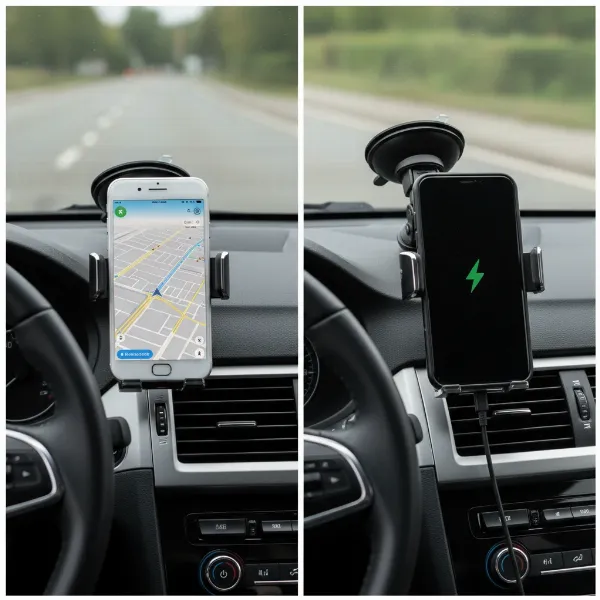 A side-by-side visual comparison of a basic phone holder and a wireless charging phone holder in a car setting, highlighting their distinct features and benefits.
How to Make Your Decision
To determine the best solution for you, ask yourself these key questions:
1. What is Your Primary Need?
If your main goal is simply to have a secure, hands-free display for navigation or calls without worrying about constant charging, a dedicated phone holder is a perfect, cost-effective choice. If seamless charging without cable fuss is as important as secure mounting, and you’re willing to accept potentially slower charging, then an integrated wireless charging phone holder is your ideal match.
2. Does Your Device Support Wireless Charging?
Ensure your smartphone is Qi-enabled or MagSafe-compatible. If not, a wireless charging solution won’t work for you, making a passive holder or a wired charging holder your only options. Also, consider your phone case; thicker cases or those with metal can impede wireless charging.
3. What is Your Budget?
Passive phone holders are significantly more affordable. Wireless charging holders, due to their advanced technology, represent a larger investment. Determine how much you’re willing to spend for the added convenience.
4. What is Your Usage Environment?
For car use, consider how often you drive, the length of your commutes, and whether rapid charging is essential. For desk use, think about ergonomics and multi-device charging needs. In hot climates, be mindful of potential overheating with wireless charging in a car.
5. Prioritize Speed vs. Convenience
If you need the fastest possible charge, wired charging solutions (either through a passive holder with a connected cable or a dedicated high-wattage car charger) will almost always outperform wireless options. However, if the convenience of “drop and charge” outweighs the need for speed, wireless charging holders offer unparalleled ease of use.
Reputable Brands in Phone Holders and Wireless Chargers
When making your purchase, opting for products from well-regarded brands can ensure reliability, durability, and better performance.
For Dedicated Phone Holders:
- iOttie: Known for innovative mounting systems like the “Easy One Touch” series, offering strong grips and ease of use across various mount types.
- RAM Mounts: Highly regarded for rugged, versatile mounting solutions suitable for a wide range of vehicles and environments, often with modular components.
- Lamicall: Offers a variety of stable and adjustable desk and car phone holders that are generally budget-friendly yet reliable.
- Rokform & ProClip USA: Brands focusing on secure, vehicle-specific mounting solutions, often designed for robust use and precise fit.
For Wireless Charging Phone Holders and Chargers:
- Anker: A leading brand in charging accessories, offering reliable and fast wireless car chargers, often incorporating magnetic mounts and advanced Qi2 technology for efficiency.
- Belkin: An Apple-certified partner, known for high-quality MagSafe-compatible car chargers and stands that provide secure attachment and optimal charging speeds for iPhones.
- ESR: Offers a range of MagSafe and Qi2 compatible wireless car chargers, often featuring strong magnetic locks and intelligent heat management.
- iOttie: Also extends into the wireless charging holder market, providing solutions that combine their popular mounting mechanisms with Qi wireless charging.
- Mophie: Known for its Snap+ series, offering versatile wireless charging vent mounts, often with removable chargers for added flexibility.
- Scosche: Provides a variety of charging solutions, including magnetic mounts with wireless charging capabilities, focusing on secure hold and user-friendly designs.
These brands often stand out for their commitment to safety features, robust construction, and compatibility with a broad range of devices, ensuring a worthwhile investment.
Conclusion
Choosing between a phone holder and a wireless charger, or a combination of both, ultimately hinges on your personal requirements. Dedicated phone holders provide straightforward, secure mounting and are an excellent choice if affordability and a pure hands-free viewing experience are your top priorities. They are universally compatible and avoid any heat-related concerns associated with charging.
On the other hand, wireless charging phone holders offer the ultimate convenience, integrating secure phone placement with cable-free power delivery. While they generally provide slower charging speeds than wired connections and may generate heat, their seamless “drop and charge” functionality and clutter-free design are significant advantages for those seeking a modern, streamlined solution. For drivers, this integration means less fumbling and more focus on the road, enhancing safety.
Ultimately, the best option is one that aligns with your phone’s capabilities, your driving habits, your typical usage environments, and your budget. Evaluate your needs carefully, consider the trade-offs in speed, cost, and convenience, and choose the solution that best enhances your daily interactions with your mobile device. What factors do you prioritize most when choosing how to secure and charge your phone on the go?
Frequently Asked Questions
Is wireless car charging slower than wired charging?
Yes, generally, wireless car charging is slower than wired charging. While high-wattage wired chargers can provide rapid power, most wireless car chargers deliver between 10-15W, with some newer Qi2/MagSafe options reaching up to 25W for compatible devices. This might be sufficient for maintaining battery levels but often won’t offer a quick top-up during short drives.
Can my phone overheat with a wireless car charger?
Yes, there is a possibility of your phone overheating, especially when using a wireless car charger in a hot car interior or during prolonged navigation with screen-on. Wireless charging generates some heat, and combined with ambient high temperatures, this can cause your phone to warm up. Overheating can slow down charging or, in extreme cases, potentially impact battery health. Look for chargers with intelligent heat management.
Are magnetic phone holders safe for my phone?
Modern magnetic phone holders, especially those designed with MagSafe compatibility, are generally safe for your phone. The magnets used are typically not strong enough to cause permanent damage or data loss to your device’s internal components. However, it’s always recommended to use high-quality, reputable brands and ensure proper alignment for optimal performance and safety.
Do I need a special phone case for wireless charging holders?
For optimal wireless charging, it’s best to use a thin, non-metallic phone case. Thick cases or those with metal plates (other than MagSafe-compatible rings) can interfere with the wireless charging signal, leading to slower charging or no charge at all. If you have an iPhone 12 or newer and a MagSafe-compatible wireless charging holder, a MagSafe-compatible case will ensure the strongest magnetic attachment and most efficient charging.